
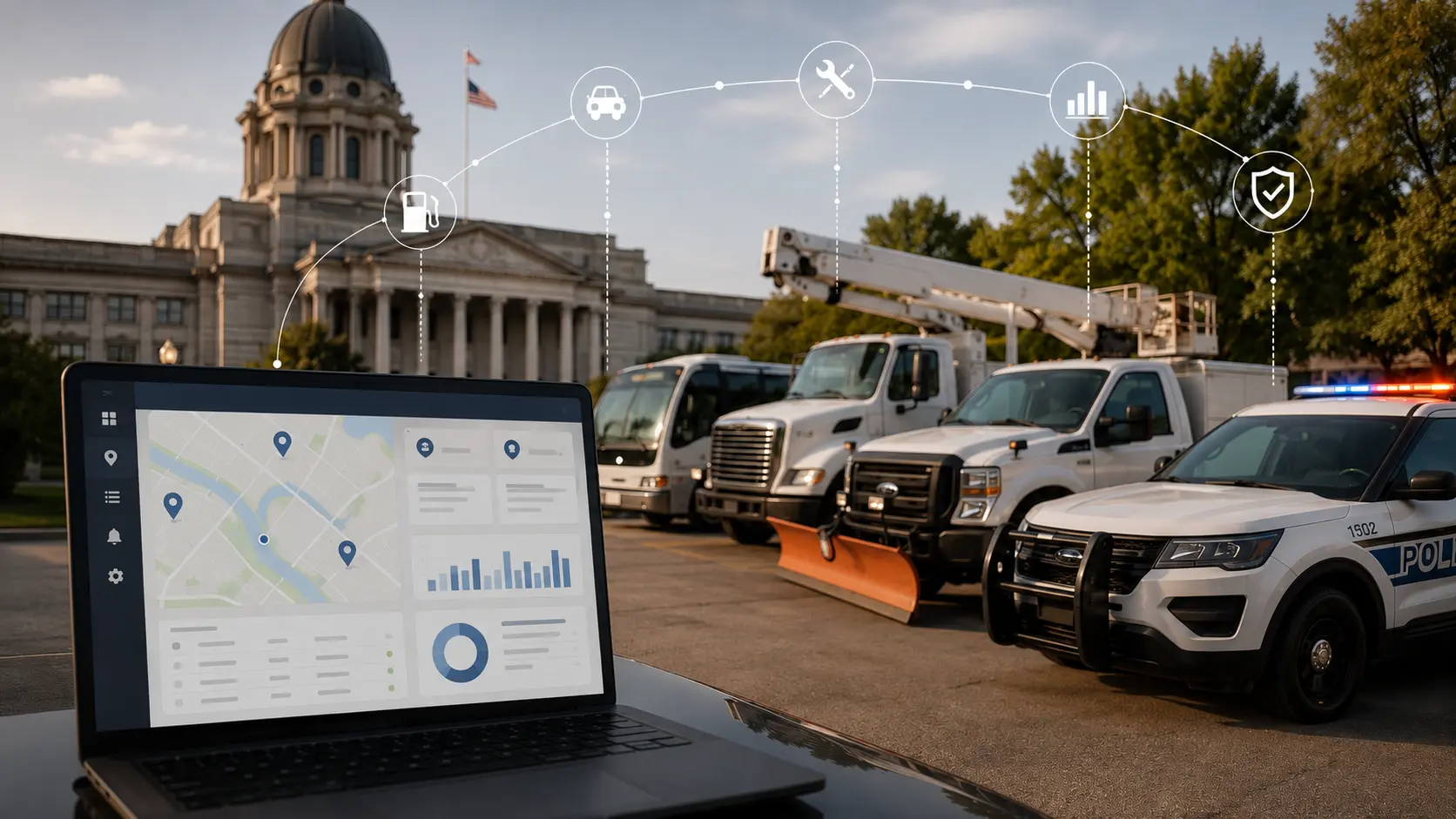
Government fleet tracking is the use of GPS and telematics to monitor the location, usage, condition, and cost of publicly owned vehicles and equipment. Every agency that runs vehicles already pays for them. Far fewer can prove what those vehicles are actually doing.
That gap is expensive. A GAO review of federally owned vehicles found two agencies carrying an estimated $13.5 million in depreciation and maintenance costs in a single fiscal year for vehicles whose utilization they could not even determine.
The benefits below are the ones that matter to the people who sign off on fleet budgets and answer for them publicly. Each is tied to a documented outcome rather than a vendor promise.
What Government Fleet Tracking Actually Covers
Government fleet tracking combines live GPS location with engine data, maintenance records, and utilization reporting across a public agency's vehicles and equipment.
The scope is what separates it from commercial tracking. A city runs patrol cars, ambulances, plows, buses, backhoes, and generators, often across departments that answer to different directors. Useful government fleet management software has to hold all of it in one place.
The second difference is accountability. Private fleets answer to a P&L. Public fleets answer to auditors, councils, and residents who can request the records.
10 Benefits of Government Fleet Tracking
We’ve worked with government fleets for over 25 years, and the benefits we see them appreciate the most often are:
1. Right-Sizing the Fleet You Already Own
The fastest savings come from removing vehicles nobody needs, and utilization data is the only defensible way to identify them.
The GAO documented this directly. At the Department of Energy's Idaho National Laboratory, telematics data helped officials eliminate 65 leased vehicles for an estimated annual savings of roughly $390,000.
Federal agencies are already required to work this way. GSA's Federal Management Regulation obligates them to apply a vehicle allocation methodology to find the optimum fleet size and identify unnecessary vehicles, with a review recommended at least every five years.
Most states and municipalities are not bound by that rule, but the method transfers cleanly, and every underused unit carries insurance, registration, depreciation, and maintenance whether it moves or not.
2. Cutting Fuel Waste and Idling
Idling is the largest recoverable fuel cost in most public fleets, and it is invisible without tracking.
U.S. vehicles waste over 6 billion gallons of fuel a year idling, according to the Department of Energy. Public fleets are heavy contributors, since crews idle at job sites, patrol units idle on post, and plows idle through shifts.
Track Star reads idle time from the engine data it already pulls and ties each event to the location where it happened. That gives a fleet director a ranked list of the sites and departments burning the most fuel rather than a fleet-wide average nobody can act on.
3. Extending Vehicle Life Through Preventive Maintenance
Tracking moves maintenance from a calendar to actual usage, which matters more in government than almost anywhere else.
A plow, an ambulance, and an administrative sedan wear at completely different rates, and mileage captures almost none of it. Scheduling on engine hours and live diagnostic codes catches wear before it becomes a failure.
Preventive maintenance in Track Star triggers on hours, mileage, or fault codes and opens the work order automatically. We have reported up to 30% lower maintenance costs across our customer base, and for a fleet operating on a replacement cycle, it stretches every year the agency can defer buying a new unit.
4. Proving Service to the Public
Public agencies get asked to prove they showed up. Government fleet tracking answers that question with a record instead of a recollection.
When a resident says the street was never plowed or the crew never arrived, GPS history and geofence timestamps settle it in minutes. That same record supports service-level reporting to a council or a state agency.
For example, Fulton County's Public Works department had almost no visibility into its field technicians before deploying Track Star. It reached 100% real-time visibility across a mobile workforce serving more than a million residents, which turned service questions into a lookup rather than an investigation.
5. Faster, Better-Coordinated Emergency Response
Location data shortens response times because dispatchers stop guessing which unit is closest.
This is the clearest life-safety benefit in the list. Live tracking lets dispatch send the genuinely nearest available unit, and during storms or major incidents it keeps command aware of where every crew is working.
Track Star supports CAD and AVL integration, so the same location feed reaches the dispatch systems that police, fire, and EMS teams already use rather than sitting in a separate window.
6. Audit-Ready Compliance Records
Compliance records are a byproduct of daily operation when tracking is in place, and a fire drill when it is not.
Public agencies running commercial vehicles fall under FMCSA rules for hours of service, inspections, and maintenance recordkeeping. Grant-funded programs add their own reporting. Auditors can request records on short notice.
Keeping inspections, driver qualification files, and maintenance history inside one fleet compliance system means producing them is a search rather than a week of digging through folders.
7. Defensible Evidence When a Claim Is Filed
Video and telematics data protect agencies from claims that would otherwise settle on the strength of one person's account.
A municipality sued over a collision involving a city vehicle is defending public money. Objective footage and speed data resolve those disputes far faster, and they exonerate operators more often than they implicate them.
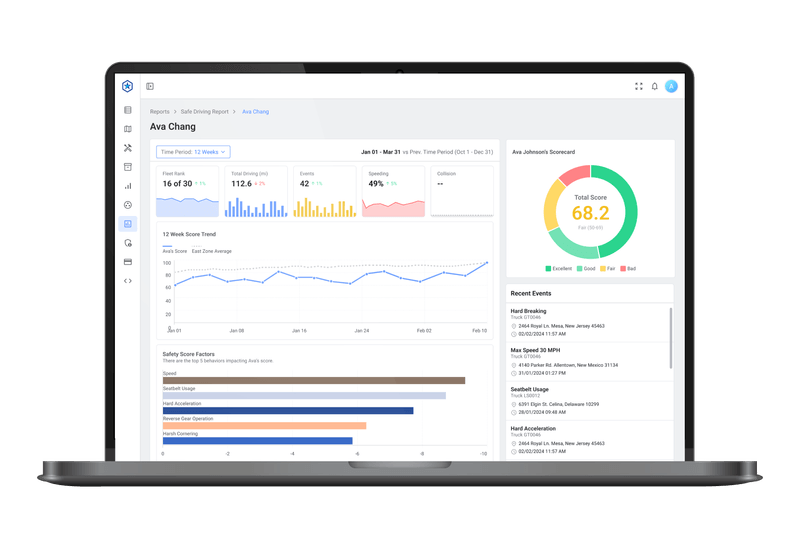
Track Star's AI video telematics flags distracted driving and fatigue in the moment and produces on-demand footage after the fact. Paired with driver safety scoring, it also gives supervisors something to coach on before a claim ever happens.
8. Budget Requests Backed by Data
Nothing strengthens a vehicle replacement request like utilization and maintenance history the council can see.
Officials asking for capital funding usually argue from age and anecdote. Tracking replaces that with cost-per-mile by unit, repair frequency, downtime, and utilization rates, which turns a request into a documented case.
The same data works in reverse. When a department asks for another truck, fleet reporting can show whether existing vehicles in that class are actually being used, which prevents a fleet from quietly growing back after right-sizing.
9. Tracking the Equipment, Not Just the Vehicles
Public agencies own far more than vehicles, and most tracking systems ignore everything without a VIN.
Generators, trailers, mowers, compactors, light towers, and portable pumps all carry real value and real theft exposure. When they live on a spreadsheet, nobody knows their condition or where they ended up after the last job.
Track Star combines telematics with enterprise asset management, so a truck, the trailer behind it, and the generator in the bed all sit in one record. That is also what makes accurate government asset tracking possible across departments that historically kept separate inventories.
10. Theft Deterrence and Faster Recovery
Tracked assets get recovered. Untracked ones usually do not.
Municipal yards and job sites are soft targets, and equipment often disappears overnight with no witnesses. A geofence around the yard flags the departure in real time instead of the next morning.
Track Star reports a 90% asset recovery rate across its customers, and in one deployment, a rental operation losing compact loaders recovered $140,000 in stolen equipment within a year. For a public agency, that is replacement money that stays in the budget.
Choosing Government Fleet Tracking Devices
Hardware decisions matter more in the public sector because agencies rarely start from scratch.
Most fleets already have something installed. Police units often carry modems for other systems, newer vehicles stream OEM data, and older units may have plug-in devices from a prior contract. Government fleet tracking devices should work with that mix rather than requiring a full replacement.
Track Star is hardware agnostic, supporting OEM feeds, existing modems, OBD-II devices, BLE tags, and third-party sensors. For an agency evaluating GPS fleet tracking for local government use, that flexibility usually decides whether a deployment fits the budget cycle or blows through it.
The second consideration is integration. Fleet data that cannot reach your GIS, CAD, ERP, or finance system creates manual work forever, which is why open API integrations belong on the requirements list from the start.
Where Track Star Fits
Public fleets fail with tracking software for a predictable reason. They buy a telematics tool for vehicles, a separate system for equipment, and keep compliance in a filing cabinet.
Track Star was built to hold all of it. GPS tracking, maintenance, compliance, video, and asset management run in one platform, so a plow, an ambulance, and a generator are the same kind of record.
That focus comes from 25 years of enterprise deployments, much of it in public-sector work where accountability is not negotiable. Ride Connection, a passenger transportation agency, consolidated 15 separate systems onto Track Star and now delivers over 500,000 rides a year with full visibility and streamlined compliance.
Final Thoughts
Government fleet tracking pays for itself in ways an official can defend in public. It finds the vehicles nobody drives, cuts the fuel that disappears at idle, keeps maintenance ahead of failure, and produces the records that answer a resident, an auditor, or a council member without a scramble.
Track Star brings that tracking, maintenance, and asset visibility into one platform built for agencies that answer to the public. Schedule a call, and we will map it to the vehicles and equipment your agency runs today.
Frequently Asked Questions
Is GPS tracking of government employees legal?
Yes, on publicly owned vehicles during work hours. Most disputes involve disclosure or union agreements rather than legality, so agencies should notify staff and check collective bargaining terms before deploying.
Can the public request our fleet GPS data?
Often yes, under state open records laws. Exemptions frequently cover law enforcement and security-sensitive locations, though the specifics vary by state, so consult your agency counsel on retention and release.
How do we fund fleet tracking on a tight budget?
Many agencies fund it from documented fuel and right-sizing savings, or through cooperative purchasing contracts. Some public safety and infrastructure grants also cover telematics as eligible equipment.
Can one system cover police, public works, and transit?
Yes, and consolidation is usually the point. A single platform like Track Star set up with department-scoped permissions lets each director see their own assets while the fleet office keeps a jurisdiction-wide view.
Does tracking help with EV transition planning?
It does. Trip-length, duty-cycle, and idle data show which vehicles are realistic candidates for electrification and where charging infrastructure would actually be needed.
%2019.04.12_d9965f53.jpg)

