

If you are evaluating a transportation management system, you are probably focused on routing, dispatching, and delivery efficiency. That is exactly what TMS platforms are built for.
But here is the gap most fleets only realize later.
A transportation management system does not give you full visibility into what is actually happening on the road. It plans the work. It does not monitor reality.
This guide breaks down what TMS software providers typically offer, where they fall short, and why fleets that rely only on logistics tools often struggle with execution, compliance, and asset performance.
What a Transportation Management System Actually Does Well
A transportation management system is designed to optimize logistics.
Most TMS software providers focus on:
- Route planning and optimization
- Load management and dispatching
- Carrier selection and freight cost control
- Delivery scheduling and coordination
If your goal is to move goods from point A to point B as efficiently as possible, TMS platforms do a solid job.
They are especially valuable for high-volume logistics operations, freight brokers, 3PLs and companies managing complex delivery networks.
That is why many businesses consider them among the best transportation platforms for logistics planning.
But planning is only one side of the equation.
Where TMS Software Providers Fall Short
The biggest misconception is that a transportation management system gives you full operational control.
It does not.
Most TMS platforms operate at the logistics layer. They do not deeply monitor what is happening at the vehicle or driver level.
Here is where the gaps show up.
1. No Real-time Visibility Into Vehicle Behavior
A TMS can tell you where a delivery should be.
It usually cannot tell you how the vehicle is being driven, whether the driver is speeding or idling excessively, or if the route is being followed in real conditions
Without that visibility, you are managing assumptions, not operations.
2. Limited Insight Into Vehicle Health and Maintenance
Breakdowns do not show up in a TMS until they disrupt a schedule.
What is missing is engine diagnostics, preventive maintenance alerts, and early warning signs of failure.
This is a major issue for fleets running tight schedules. One unplanned breakdown can throw off multiple deliveries and push drivers into compliance risks.
3. No Connection to HOS and Compliance Data
A transportation management system may assign a route that looks efficient on paper.
But it often ignores:
- Remaining driver hours
- HOS limits and rest requirements
- Real-world delays that impact compliance
This is how fleets end up with routes that cannot legally be completed. The plan works in theory, but the driver takes the hit in reality.
4. Weak Support for Driver Safety and Behavior
Most TMS platforms are not built to monitor driver behavior.
They do not track harsh braking or aggressive acceleration, speeding trends, or risk patterns across drivers.
That means fleet safety becomes reactive instead of proactive, which is a deal-breaker for many operations that need to stay on the road.
Fleet vs Logistics Software: Why This Gap Exists
The difference comes down to focus.
Transportation management systems are logistics software. They optimize movement and cost.
Fleet management systems are operational software. They monitor vehicles, drivers, and assets in real time.
When you rely only on a TMS, you are optimizing the plan without validating execution. That is why many fleets end up layering additional tools later. Not because the TMS is wrong, but because it was never built to handle what happens on the road.
In fact, the U.S. Department of Transportation highlights that real-time vehicle data, including driver behavior and equipment condition, is critical for improving safety and operational performance.
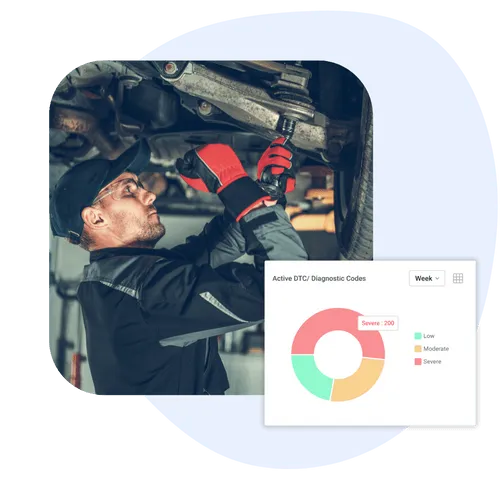
This is exactly where Track Star fits in. It acts as the operational layer that sits alongside your TMS, giving you real-time visibility into driver hours, vehicle performance, and actual route execution.
Instead of relying on assumptions, you can see how every route is playing out and adjust before small issues turn into delays, violations, or missed deliveries.
The Real-World Impact of Relying Only on a TMS
This gap is not theoretical. It shows up in daily operations.
- Unrealistic delivery windows: Routes are planned without factoring in traffic, delays, or HOS limits. Drivers are left trying to make impossible schedules.
- Inefficient routing in practice: Even optimized routes can break down in real conditions. Without live tracking, you cannot adjust in time.
- Compliance risks: Drivers may exceed HOS limits because the system did not account for real-time constraints.
- Unexpected downtime: Without vehicle health data, issues are caught too late.
At the end of the day, you cannot improve what you cannot measure. Without driver and vehicle data, performance stays uneven.
Where Track Star Fills the Gap
This is where fleets start combining systems or switching to platforms that connect both sides.
With Track Star, the focus is not just on planning routes, but on understanding how those routes play out in real time.
Instead of relying only on a transportation management system, fleets use Track Star to:
- Monitor live vehicle location and behavior
- Track driver activity and safety trends
- Get alerts for maintenance and vehicle health issues
- See remaining driver hours and avoid compliance risks
- Adjust routes dynamically based on real conditions
For example, a route planned in a TMS might assume a clean 4-hour drive.
With Track Star, you can see that traffic delays and idle time are cutting into that window, and that the driver is approaching HOS limits. Instead of pushing forward blindly, dispatch can reroute or reassign before it becomes a problem.
This is not about replacing TMS platforms. It is about making them work in the real world.
Do You Need Both TMS and Fleet Management?
In many cases, yes.
The best transportation platforms for logistics are still valuable. But they need to be paired with systems that provide real-time operational visibility.
Think of it this way:
A TMS tells you what should happen.
A fleet platform shows you what is actually happening.
Fleets that connect both are the ones that stay compliant, reduce downtime, improve driver safety, and deliver more consistently.
Final Thoughts
A transportation management system is a powerful tool. But on its own, it leaves critical gaps.
If you are dealing with missed delivery windows, compliance issues, or a lack of visibility into your fleet, the issue is not your routing logic. It is the lack of real-time operational insight.
Once you close that gap, everything else becomes easier to manage.
If you are already using a transportation management system but still struggling with visibility, it is time to connect the missing piece. Schedule a call with Track Star today.


