
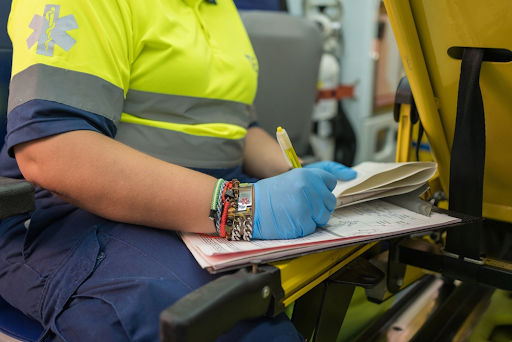
EMS compliance tracking is how an agency proves, with data rather than memory, that its units met the response and offload standards they are held to. For years, that proof came from manual timestamps and dispatcher logs, which left gaps every time a crew was focused on a patient instead of a clipboard.
Those gaps matter more than they used to. Regulators are tightening the rules, funding is tied to performance, and the clock is unforgiving. Medical research shows survival from cardiac arrest falls by roughly 10% for every minute without intervention.
Real-time EMS compliance tracking closes those gaps by capturing every stage of a response automatically, which turns response-time reporting from a paperwork exercise into an operational tool.
Why EMS Compliance Tracking Matters More Than Ever
The pressure on EMS agencies is coming from two directions at once.
On one side, response and offload standards are getting stricter and better enforced. California's AB-40, for example, now requires local EMS agencies to hold ambulance patient offload time to 30 minutes or less, 90% of the time.
The law also mandates electronic timestamps that capture exactly when an ambulance arrives and when care is transferred.
On the other side, missing or sloppy records carry real consequences, from funding reductions to liability when a slow response is questioned. Add the clinical reality that minutes decide outcomes, and accurate EMS compliance tracking stops being a back-office task. It becomes part of patient care.
From Manual Logs to Real-Time GPS Data
The old way of measuring ambulance response times depended on someone writing down a time, or a dispatcher logging it between calls. It worked until it did not, and the errors always seemed to surface during an audit.
GPS tracking for emergency services replaces that with a continuous record. The system captures when a unit is dispatched, when it goes en route, and when it reaches the scene, without anyone touching a keypad.
That live data does more than document the past. It sharpens decisions in the moment. When a call comes in, a dispatcher can see which unit is genuinely closest and available rather than guessing from a board, which trims minutes off deployment when several units are already committed.
That real-time ambulance visibility is where Track Star's live tracking earns its place, because the same feed that proves your response times also helps shorten them.
How Automated Timestamp Verification Removes Human Error
Every manual timestamp is a chance for the record to drift. A medic focused on a patient cannot stop to log a time to the second, and a dispatcher running several calls at once will not catch every entry.
Automated timestamp verification removes that weak point by capturing times from the systems themselves rather than from people.
This is where integration matters. For example, Track Star connects to Computer-Aided Dispatch, so the moment a call is assigned, the notification time is recorded on its own. GPS then marks when the unit started rolling and when it arrived, and the handoff time can flow in from the electronic patient care record.
The result is a complete, defensible timeline for every call, built without adding a single step to a crew's workload. When an auditor asks how a response time was measured, the answer is the system, not someone's memory.
Geofencing the Hospital and the Service Area
Geofencing turns specific locations into automatic compliance checkpoints. Draw a boundary around a hospital, and the system stamps the second an ambulance arrives at the emergency department and the second it leaves. That gives you offload time with nobody tracking it by hand, which is exactly what a rule like AB-40 demands.
With Track Star, those hospital geofences feed the same record as everything else, so an offload that runs long surfaces immediately instead of in a monthly report.
The same approach covers your service area. Set a boundary around the zone a unit is responsible for, and dispatch gets an alert when coverage thins or a unit drifts out of position. For agencies that lean on mutual aid, that visibility extends across fire and rescue fleets too, so a large incident does not become a guessing game about who is where.

Turning Response Data Into Better Performance
Once the data is accurate, it becomes worth analyzing. A full history of response times shows where the real delays live, whether that is a particular intersection at rush hour or a shift that consistently runs behind. Agencies use that to reposition units and to make the case for more resources with evidence rather than anecdote.
Benchmarking gets sharper too. Clean data lets an agency measure itself against state standards and its own past performance, and confirm whether a change actually moved the needle.
Track Star keeps that response data in one place and turns it into reporting a chief can hand to a county board or a regulator without spending a week rebuilding it from spreadsheets.
Staying Connected When the Network Is Strained
All of this depends on the data getting out of the vehicle, and that is hardest during the exact events when it matters most.
A major incident can overwhelm commercial cell networks just as every unit is in motion. Track Star is hardware-agnostic and works with networks built for first responders. Because many emergency vehicles already carry modems and onboard systems, agencies can often connect to what is already there rather than installing new hardware.
When coverage does drop, the device holds each timestamp and sends it the moment the signal returns, so the compliance record stays intact even through a dead zone.
Where Track Star Fits
EMS compliance tracking only works when the pieces are connected, and that is the whole idea behind Track Star. The GPS feed, the CAD timestamps, the hospital geofences, and the reporting all live in one platform built for the public-sector and emergency services fleets.
It pairs telematics with full asset and maintenance visibility, so the same system that proves your response times also helps keep the ambulances and police units behind them ready to roll. For an agency under pressure to prove performance and protect funding, that single source of truth is the difference between scrambling for records and simply having them.
Final Thoughts
For an EMS agency, the clock is the job, and the record of that clock is what keeps your funding and the public's trust intact. Manual logs were never built for that kind of scrutiny.
Real-time EMS compliance tracking is, because it captures every response automatically and proves your offload and response times without argument, all while helping shave the minutes that change outcomes.
Track Star brings that tracking, dispatch integration, and reporting together in one platform built for the agencies that cannot afford to be wrong. Schedule a call, and we will show you how it would work on the units you run today.
Frequently Asked Questions
What is ambulance patient offload time?
It is the time between an ambulance arriving at a hospital and the patient being formally handed off to emergency department staff. California's AB-40 sets a standard of 30 minutes or less, 90 percent of the time, and several other states are watching that model closely.
Does GPS tracking replace our CAD system?
No, it works alongside it. The tracking platform integrates with CAD so dispatch times flow in automatically, while CAD still handles call-taking and unit assignment. Together they produce one verified response timeline instead of two records that have to be reconciled later.
How does compliance tracking actually improve response times?
It surfaces the patterns behind slow runs, like a recurring intersection bottleneck or a unit that is often out of position, and it lets dispatch send the genuinely closest crew. Fixing those specific causes is what brings the average down, not the tracking itself.
Can EMS tracking data be used in a lawsuit?
It can. An automatic, time-stamped record of a response is usually stronger evidence than handwritten logs, so accurate tracking can protect an agency as much as it documents performance. How it is used varies by case, and this is general information rather than legal advice.
Is GPS tracking on ambulances an invasion of crew privacy?
Tracking on agency-owned vehicles during shifts is standard and generally accepted, especially when the focus is response performance rather than individual behavior. A clear written policy that explains what is tracked and why tends to settle most crew concerns quickly.


