

Geofence tracking is the ability to draw a virtual boundary around any location and get an instant alert the moment one of your assets crosses it. That sounds simple, but the real geofence tracking benefits show up in the timing.
Knowing a piece of equipment left a job site at 2 a.m. is useful the next morning, but knowing it the second it happens is what actually saves the asset. For fleets running vehicles and equipment across dozens of sites, geofence tracking turns a map full of dots into a system that tells you when something is wrong while you can still do something about it.
What Geofence Tracking Actually Does
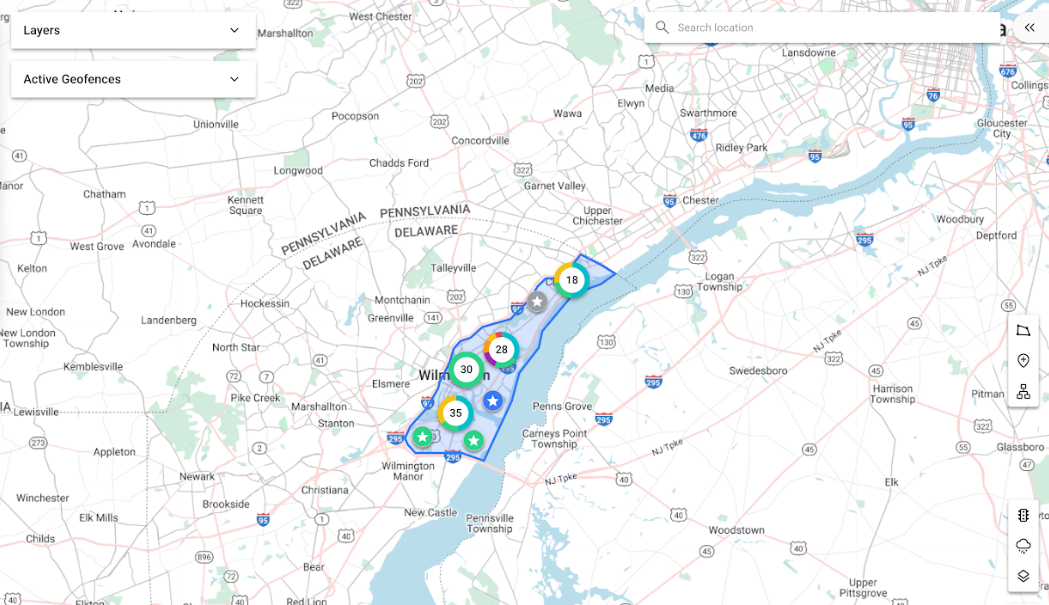
A geofence is a digital perimeter you set around a point on the map. It might be a yard, a customer site, a restricted zone, or a stretch of route.
When a tracked vehicle or asset enters or exits that perimeter, the system logs the crossing and can fire an alert by text, email, or in-app notification.
4 Core Benefits of Geofence Tracking
Once the alerts start flowing, the payoff lands in a few specific corners of the operation. Each one maps to a problem most fleet managers already lose sleep over.
1. Catching Theft Before the Trail Goes Cold
Equipment theft is a bigger problem than the industry likes to admit. The NICB estimates that construction and farm equipment theft costs somewhere between $300 million and $1 billion a year, and fewer than a quarter of stolen machines are ever recovered.
The reason recovery stays so low is timing. A skid steer can be loaded onto a trailer and gone in minutes, and if nobody notices until the crew shows up the next morning, the trail is already cold.
This is where geofence GPS tracking earns its place. Draw a boundary around the job site, and the moment a tracked machine crosses it outside working hours, you get an alert with the asset's live location.
That gives you and law enforcement a real shot at acting while the equipment is still close. The same approach protects heavy equipment parked on remote sites, and it is exactly why so many crews now pair construction equipment tracking and rental equipment protection with site geofences.
2. Turning Job-Site Boundaries Into Accountability
Geofences are not only about what goes missing. They are also a quiet way to keep honest records of who was where and for how long.
When a crew vehicle enters a site, the geofence stamps the arrival time. When it leaves, that gets logged too. Used this way, geofence time tracking gives you arrival and departure data that nobody has to write down, and nobody can fudge after the fact.
That matters more than it sounds. The American Payroll Association has long estimated that time theft quietly drains a real slice of gross payroll at most companies, much of it from rounded start times and stretched lunches that never look like much on their own.
Geofence-based timestamps replace the honor system with a record, which is basically what a vehicle monitoring system does. For public works and utility crews billing time against specific jobs, that accountability also makes cost allocation far cleaner.
3. Keeping Vehicles Where They Belong
Plenty of fleet losses have nothing to do with theft. A take-home vehicle wanders well outside its service area on a Sunday. A truck sits idling at a location it has no business visiting.
These small leaks rarely surface in any report until you go looking for them. A geofence flips that around. Set boundaries around approved zones, and anything outside them shows up on its own.
For example, Track Star lets you build those zones around districts, depots, or individual customer sites, so vehicle usage accountability stops depending on someone manually combing through trip logs.
4. Faster Response When Location Decides the Outcome
In time-critical work, a geofence is less about catching problems and more about speeding up the right reaction. Dispatchers managing emergency vehicles can be alerted the instant a unit enters or clears a response zone, which tightens coordination when seconds count.
Utility crews rolling out for storm response get confirmed on site automatically as they cross into an affected area. For public safety teams, geofences around restricted areas and staging zones add a layer of awareness that pairs naturally with police fleet management software already built for that environment.
Why Geofence Accuracy Matters More Than You Think
Here is the part most benefit lists skip. A geofence is only as good as the location data behind it, and that is where cheap setups fall apart.
According to GPS.gov, the official U.S. government source on the system, GPS-enabled devices are typically accurate to within about 4.9 meters under open sky, and that margin widens near buildings and under dense tree cover.
Draw your geofence too tightly, and normal GPS drift will trigger a stream of false entry and exit alerts until your team stops trusting them entirely.
The fix is partly how you size the zone and partly the quality of the hardware feeding it. Purpose-built fleet trackers hold a tighter fix than a phone or a bargain device, and a good platform lets you add a small buffer so everyday parking movement does not set off alarms.
This is one reason geofencing works best as part of a real GPS fleet tracking system rather than a standalone gadget. The location data and the alerting have to come from the same reliable source.
Getting More From Geofence Tracking
Geofence tracking gets far more powerful when it stops living on its own. By itself, it tells you when something crossed a line. Connected to the rest of your operation, that same crossing can update utilization records, flag an asset for maintenance based on where it has been, and feed cleaner numbers into your reports.
That is the advantage of running geofences inside a unified platform like Track Star, where tracking sits alongside enterprise asset management, and everything you monitor lives in one place.
For a mixed fleet of vehicles, trailers, and powered equipment, this matters even more. Because Track Star is hardware agnostic, you can geofence anything you can track, so trailers and generators carry the same boundary logic as your trucks through the GPS asset tracking system.
The result shows up in your fleet management reporting, where geofence data becomes one more accurate input instead of a separate spreadsheet nobody reconciles. If you want to see what that visibility is worth on your own numbers, the fleet ROI calculator is a quick way to estimate it.
Final Thoughts
The thread through all of this is timing. Geofence tracking only pays off when the alert reaches you while you can still act on it, and when the location data behind it is accurate enough to trust. Get both right and the payoff is real.
Track Star brings that geofencing into one platform built for complex, mixed fleets. Schedule a call and see it mapped to the sites and assets you run.
Frequently Asked Questions
How many geofences can I set up at once?
Most capable platforms like Track Star set no hard limit. You can map every yard, job site, and restricted zone separately, each with its own alert rules, so geofence coverage scales right alongside your fleet.
Do geofence alerts work without a cell signal?
Yes. Quality trackers store boundary crossings on the device and send the alert once connectivity returns, so a geofence still records the event even when a vehicle passes through a dead zone.
How big should a geofence be to avoid false alerts?
Size it slightly larger than the actual location. Adding a small buffer beyond normal GPS drift keeps routine parking movement from triggering constant entry and exit alerts that your team will eventually ignore.
Can I geofence equipment that isn't a vehicle?
Yes. With Track Star & a battery-powered or hardwired tracker, you can geofence trailers, generators, and other assets, so anything valuable enough to walk off a site carries the same boundary alerts as your trucks.
Is geofencing worth it for a small fleet?
Yes. Even a handful of vehicles benefit, since one prevented theft or recovered asset usually covers the cost. Geofence alerts scale down to small fleets just as cleanly as large ones.