
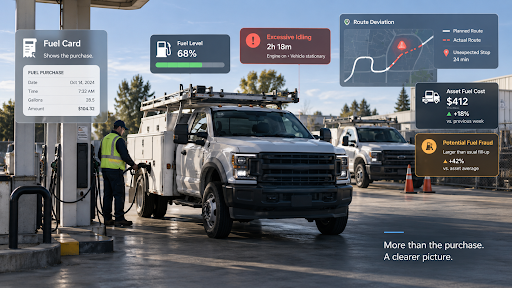
A fuel card tells you what you paid. It never tells you why. You get a gallon count, a dollar amount, a location, and a timestamp, and then it stops. That is the blind spot at the center of most fleet fuel management: everything that actually drives your fuel spend, including the idling, the off-route trips, and the fill that went into a personal truck, happens in the gap the card cannot see.
That gap is the whole problem with running fuel management on card data alone. You get a clean record of the transaction and no record of the behavior behind it. Telematics closes that gap, and it is where fuel spend stops being a fixed cost and starts being controllable.
What a Fuel Card Actually Misses
Card data answers one question: how much fuel was purchased, and where. Useful, but shallow. The card cannot tell you whether that fuel was burned productively or wasted, because it has no idea what the vehicle was doing.
The card sees the fill. Telematics sees the tank, the engine, and the twenty minutes of idling that made the fill necessary, but it misses idling entirely.
A truck can burn a full day of fuel sitting still, and the card shows only the refill that follows. It misses off-route and after-hours driving, since a fill-up looks identical whether the vehicle was on a job or running personal errands. And it struggles with fuel card fraud, because a card swipe at a legitimate station gives no sign that the fuel went into the wrong tank.
None of that is a flaw in the card. It is simply the limit of what a payment record can know.
How Telematics Closes the Gap
Telematics fills in the part the card leaves blank: what the vehicle was doing when the fuel disappeared. Because Track Star is hardware agnostic and reads engine data directly from the vehicle through OEM feeds, modems, or an OBD-II connection, it sees consumption and idling as they happen rather than after the fact at the pump.
That changes fleet fuel management from bookkeeping into diagnosis. Instead of a monthly total, you get the behavior behind it, tied to a specific vehicle, driver, time, and place. The fleet fuel management view shows where the fuel actually went, not just where it was bought.
1. Catch Idling Where It Happens
Idling is the largest waste most fleets never see, precisely because a card cannot record it. Track Star reads idle time from engine data and ties each event to the location where it occurred.
Picture a service van that sits running for an hour at every stop to keep the cab warm. The card shows a normal weekly fill. The telematics shows where that fuel actually went.
The result is specific. Rather than a vague sense that crews idle too much, you get a ranked view of which vehicles, sites, and shifts burn the most fuel sitting still. That is the difference between a policy nobody enforces and a list a supervisor can act on this week.
2. Turn Card Data Into Exception Reporting
Fuel visibility isn't about more dashboards. It is being told when something is wrong. Exception reporting flags the transactions and patterns worth a second look instead of asking you to read every line.
When you pair fuel events with what the vehicle was doing, the exceptions surface on their own. A purchase while the vehicle was parked miles from the station. A second fill hours after the tank was already full.
Consumption that jumped without a matching change in work. Each of these is a signal a card alone would bury in a normal-looking statement, and each is where fuel card fraud and simple waste tend to hide.
3. See Cost Per Asset, Not Just Fleet Totals
A fleet-wide fuel number hides more than it reveals. The average looks fine while a handful of vehicles quietly run up the bill. Cost per asset is where the real decisions live.
Because Track Star keeps fuel data in the same platform as tracking, maintenance, and asset records, you can see fuel cost against each specific vehicle rather than a lump sum.
A unit whose fuel cost is climbing often has a mechanical cause, which is why connecting fuel data to preventive maintenance matters: a failing injector or a dragging brake shows up as rising consumption before it shows up as a breakdown. That per-asset view also feeds cleaner fleet reporting when you need to justify a budget or retire a vehicle.
Why the Unified View Wins
Fuel is rarely a standalone problem. Idling ties to driver behavior, rising consumption ties to maintenance, and off-route fuel ties to routing. Handled in a separate fuel tool, those connections are invisible.
Track Star keeps fuel alongside telematics, maintenance, and asset management in one platform, so a fuel exception, the driver behind it, and the vehicle's service history are one record instead of three. For fleets in government, utilities, and public safety that answer for every dollar, that single view is what makes fuel spend defensible rather than just reported.
Final Thoughts
A fuel card will always tell you what you spent. It will never tell you what you wasted. Real fleet fuel management needs the layer the card cannot provide: the idling, the exceptions, the per-asset cost, and the behavior behind every gallon.
Track Star brings fuel data together with telematics, maintenance, and reporting in one platform built for fleets that cannot afford to guess where their fuel goes. Schedule a call, and we will show you the spend your fuel card has been hiding.
Frequently Asked Questions
Does fleet fuel management replace our fuel cards?
No. Cards still handle payment. Telematics adds the missing context by showing what each vehicle was doing when fuel was used, so the two work together rather than one replacing the other.
How is fuel data captured without a sensor in the tank?
Track Star reads fuel and engine data from the vehicle's own systems through OEM feeds, a modem, or an OBD-II connection, so most fleets get consumption and idling data without installing a separate fuel sensor.
Can we still use telematics fuel data if crews fuel at a private yard tank?
Yes. Because the data comes from the vehicle rather than the point of sale, on-site or bulk fueling is captured the same way as retail fill-ups, which is often where card visibility is weakest.
Can idling really add up to meaningful fuel cost?
Yes. A vehicle burns fuel whenever the engine runs, including hours spent stationary that a fuel card never captures. Idle time is often the single largest recoverable cost in a fleet's fuel budget.
Does this work with the vehicles and hardware we already have?
Usually yes. A hardware-agnostic platform reads fuel and engine data through OEM feeds, existing modems, or OBD-II devices, so most fleets can add this visibility without replacing equipment across every vehicle.


