
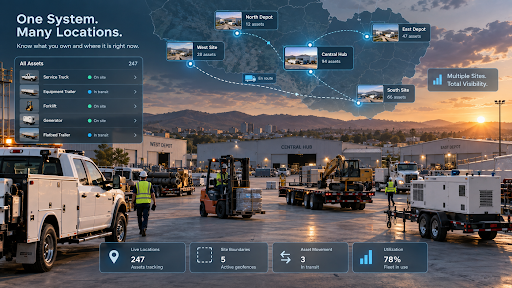
Enterprise asset tracking is the practice of monitoring every vehicle, piece of equipment, and movable asset an organization owns across all of its locations, from one system. In a single yard, that is simple.
Spread across a dozen depots, regional offices, and job sites, it becomes the problem that quietly costs organizations the most: nobody can say, with confidence, what they own and where it is right now.
Multi-site operations rarely fail for lack of data. They fail because the data lives in separate places. Each depot runs its own spreadsheet and its own version of the truth, and the moment an asset crosses from one site to another, it falls into a gap. Enterprise asset tracking exists to close that gap.
What Enterprise Asset Tracking Actually Means
Enterprise asset tracking combines live location with condition and usage history for an organization's full asset base, held in one enterprise tracking system rather than scattered across sites. The word that matters is enterprise. This is not tracking a handful of vans. It is tracking hundreds or thousands of assets that belong to different departments, sit at different locations, and rarely stay put.
That scale changes the requirements. A tool built for one site assumes everything is nearby and everyone shares a view. An enterprise tracking system has to assume the opposite: assets constantly move, teams are separated, and no single person sees the whole picture without help.
Why Multiple Sites Break Single-Site Tracking
The trouble starts at the boundaries between sites. A loader tracked perfectly at Depot A becomes invisible the moment it is trailered to Depot B, because the two run separate systems that never talk to each other.
From there, the problems compound.
- Assets get double-counted when each site logs them on its own, and nobody reconciles.
- Utilization reads wrong, because a machine sitting idle at one yard is invisible to a manager across town who just rented a replacement he did not need.
- Accountability vanishes at the handoff, since no record follows the asset across the line.
The result is an organization that owns plenty and trusts none of its own numbers. Budgets get built on guesses, and the guesses usually run in the expensive direction.
4 Things Real Multi-Site Asset Visibility Requires
Multi-site asset visibility is not a feature you switch on. It is the outcome of a few requirements working together. Here is what actually delivers it.
1. One System, Not One Per Site
The foundation is a single platform every site reports into. Separate tools per depot guarantee blind spots, no matter how good each one is on its own. A real enterprise tracking system holds every location in one place, so headquarters and each site look at the same live data.
Track Star is built around exactly this, pairing GPS tracking with enterprise asset management so the whole organization shares one record.
2. Coverage for Every Asset Type
Multi-site operations rarely track just vehicles. There are trailers, generators, tools, and fixed equipment scattered across yards and buildings. If your system only handles things with a VIN, half your assets stay invisible.
Because Track Star is hardware agnostic, it tracks assets through GPS, OEM data, OBD-II, and BLE tags, so a powered machine and a battery-tagged tool crib both live in the same asset tracking system.
3. Site Boundaries That Track Movement
Visibility across sites depends on knowing when an asset arrives at and leaves each one. Geofencing turns every depot, yard, and job site into a boundary that logs entries and exits on its own.
That is how an asset stays on the map as it moves between locations, instead of dropping off the second it leaves its home base. The crossing gets recorded, and the chain of custody stays intact.
4. Access That Respects Who Needs What
At enterprise scale, not everyone should see everything. A site supervisor needs their own location's assets, while an asset director needs the view across all of them. Role-based access makes multi-site asset visibility practical rather than overwhelming, giving each person the slice they manage without burying them in the rest.
Miss any one of these and visibility breaks at the seams. Together, they turn a collection of sites into a single operation you can actually see.
Turning Visibility Into Better Utilization
The payoff of enterprise asset tracking is not just knowing where things are. It is using what you own more fully. When every site shares one view, an idle machine at one depot becomes an obvious answer to a shortage at another, instead of a reason to rent or buy.
Utilization data also settles the recurring enterprise argument about whether to add equipment.
Track Star's reporting software shows how hard each asset actually works across the whole organization, so a request for another unit can be checked against what is already sitting unused somewhere else. That single view is what stops a multi-site operation from quietly buying capacity it already has.
Keeping Maintenance Whole Across Every Site
Assets that move between sites are notoriously hard to maintain, because service history gets split across locations. A truck serviced at one depot shows up at another with no record of what was done, and the next problem gets diagnosed from scratch.
When maintenance lives in the same platform as tracking, that history follows the asset. Track Star ties usage data to preventive maintenance and opens a work order automatically, so a machine's service record stays whole no matter how many yards it passes through.
Where Track Star Fits
Most tracking vendors handle one site and one asset type well, then leave the enterprise to stitch the rest together. Track Star was built for the opposite case. It combines GPS tracking, telematics, and enterprise asset management in one platform designed for organizations running hundreds or thousands of assets across many locations.
Two things make it work at that scale. It is hardware agnostic, so it connects to the mix of devices different sites already run rather than forcing a single standard. And its open API integrations let it feed the GIS, ERP, and finance systems an enterprise already depends on.
Ride Connection put this to the test. The nonprofit transportation provider was running fifteen separate systems across a largely paper-based operation, which is what enterprise asset tracking looks like when it is stitched together site by site instead of designed as one. Records lived in different places, nothing reconciled cleanly, and getting a single accurate picture of the operation meant pulling from more than a dozen sources. Consolidating all fifteen onto Track Star replaced that patchwork with one platform, so the assets, the data, and the visibility finally lived in the same place. The result was full visibility across the operation and the streamlined compliance that came with no longer chasing the same information through fifteen doors.
Final Thoughts
Across multiple sites, the hardest question is often the simplest one: what do we own, and where is it right now? Enterprise asset tracking answers that in real time, closing the gaps between depots where assets and accountability usually disappear. One system, every asset type, every location, one view.
Track Star brings that visibility together with the maintenance and reporting that make it actionable, in a platform built for organizations that operate at scale. Schedule a call, and we will show you what one view across all your sites looks like.
Frequently Asked Questions
How is enterprise asset tracking different from fleet tracking?
Fleet tracking focuses on vehicles. Enterprise asset tracking covers everything an organization owns, including equipment, tools, and fixed assets, across every site, in one system rather than a separate tool per fleet or location.
How are non-powered assets like tools or trailers tracked?
Battery-powered or BLE tags handle assets without an engine or power source. They report location and movement, so trailers, tool cribs, and similar items appear alongside powered equipment in the same platform.
Does moving to one system mean replacing what each site already uses?
Often less than expected. A hardware-agnostic platform can connect to many of the devices sites already run, so consolidation is usually about unifying the data in one place rather than ripping out every existing tracker.
Does enterprise asset tracking work across different states or regions?
Yes. Because assets report over cellular connectivity, physical distance does not limit coverage. A single system can track assets across regions, states, or nationwide sites from one dashboard.
What happens to an asset's record when it moves to a new site permanently?
The record and its full history stay in the system and get reassigned to the new site. That preserves service history and accountability instead of resetting the asset every time it changes locations.


